
A systems moment requiring coordinated, statewide leadership to ensure equitable access for the next generation.
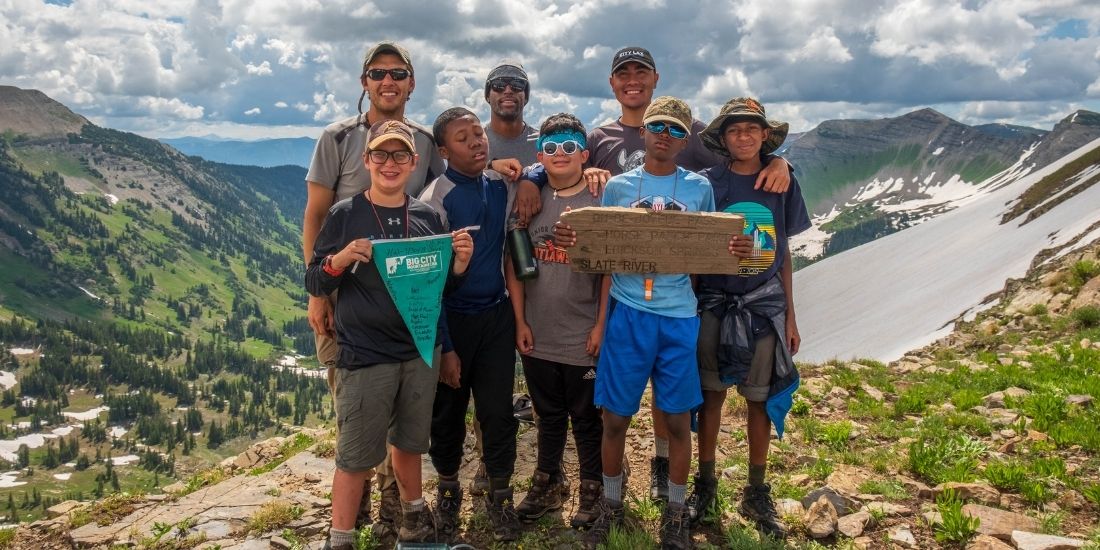
Above photo: Jason Swann works with Big City Mountaineers to take 8th graders on their first backpacking trip to Oh-Be-Joyful Pass.
Colorado’s outdoor recreation economy generates over $65.8 billion annually and supports 404,000 jobs (Colorado Parks and Wildlife, 2025), yet beneath this success lies a widening gap between economic growth and community access. Many of the very organizations that make outdoor access possible, especially POC-led, rural, and community-rooted providers, remain under-resourced, disconnected from funding systems, and excluded from decision-making tables.
Rising Routes’ statewide mixed-methods assessment (2023–24)—spanning surveys, interviews, and listening sessions with 81 outdoor providers—established a clear, evidence-backed picture of Colorado’s outdoor access ecosystem. The findings revealed fragmented networks with little access to policy information or funding systems, persistent instability among smaller, community-rooted organizations, and a consistent call for durable, year-round infrastructure to coordinate advocacy and leadership (Rising Routes, 2025). Providers were clear: without a durable, equitably structured system, historically excluded leaders are forced to react to decisions rather than help shape them.
Why Now?
Colorado is entering its most consequential outdoor policy window in a decade. Over the next several years, the state will direct tens of millions of dollars through new and existing initiatives, implement its 2025–2029 Statewide Comprehensive Outdoor Recreation Plan (SCORP) and the Colorado Outdoor Strategy, and navigate political transitions that will shape outdoor policy for generations. Decisions made during this period will determine whre parks are built, which communities receive infrastructure, and who has meaningful access to nature.
At the same time, federal programs that once bolstered equitable outdoor access are becoming less dependable. While the Land and Water Conservation Fund (LWCF) remains authorized under the Great American Outdoors Act, recent Department of the Interior directives have restricted how much of it can be used for local and community projects, reducing access for states like Colorado that have relied on it for more than 1,000 recreation and conservation investments (Colorado Parks and Wildlife, 2025; CPR News, 2025). The Justice40 Initiative, designed to direct 40% of federal climate and infrastructure benefits to disadvantaged communities, was formally discontinued in early 2025 (U.S. Government Accountability Office, 2025). Similarly, the U.S. Department of Agriculture’s Urban and Community Forestry Program saw the cancellation of over $148 million in previously awarded grants, including those aimed at expanding urban tree canopy and improving green access in underserved areas (American Planning Association, 2025). These shifts signal a new reality that federal funding for these critical needs is increasingly uncertain and insufficient to meet state and local needs.
Recent federal administrative guidance further underscores this instability. In early 2025, the U.S. Department of Agriculture issued Secretary’s Memorandum SM-1078-021, directing agencies to pause, review, or modify programs and activities associated with equity-related executive actions. While procedural in nature, the memo has had the practical effect of delaying implementation, narrowing eligibility, and increasing uncertainty for community-based programs that support access to nature, climate resilience, and environmental benefits in underserved communities (U.S. Department of Agriculture, 2025). Together, these shifts signal a new reality: federal funding for equitable outdoor access is increasingly uncertain and insufficient to meet state and local needs.
The stakes are clear that the next five years will determine where parks rise, which communities receive infrastructure, and who has access to nature. Colorado must act now to establish a first-of-its-kind, durable, statewide structure capable of sustaining and expanding access for underserved populations.
The Solution: A Statewide Outdoor Access Collaborative
This moment requires more than isolated programs or temporary coalitions. It requires a durable, statewide structure capable of aligning leadership, data, and decision-making across sectors.
In response to these conditions, Rising Routes, in partnership with Everyone Outdoors Colorado (EOC), is reestablishing the Statewide Outdoor Access Collaborative—a durable, provider-led, cross-sector infrastructure designed to coordinate, elevate, and sustain community-rooted leadership across Colorado’s outdoor access ecosystem. The Collaborative responds directly to what providers have asked for: a permanent, year-round structure that connects organizations to one another, to policy processes, and to funding systems before decisions are made.
Rather than duplicating existing programs or initiatives, the Collaborative is designed as a stewardshp model – one that strengthens alignment across Colorado’s outdoor equity landscape by linking regional engagement, grassroots leadership, and statewide advocacy into a single, coordinated framework. It creates the connective tissue between community-based providers, regional partnerships, and state-level decision-making, ensuring that those closest to the work are meaningfully involved in shaping the priorities, policies, and investments.
By formalizing collaboration among Generation Wild, Everyone Outdoors Colorado, and Rising Routes, the Statewide Outdoor Access Collaborative establishes a shared platform for governance coordination, policy development, information sharing, and collective action. Together, these partners bring complementary strengths, such as regional reach, civic and advocacy capacity, and provider-centered infrastructure, creating a unified statewide partnership capable of advancing equitable outdoor access at scale and over time.
Want to get involved?
Join our Provider Network, or contact us if you have any questions.